


- WEBSITE -





Current location: HOME > NEWS > Frequently Asked Questions >
Installation Precautions and Misalignment Solutions for Double-Layer Roll Forming Machines
Time:2026-10-29 04:47:03 Author:xiangyi Click:89
Installation Precautions and Misalignment Solutions for Double-Layer Roll Forming Machines
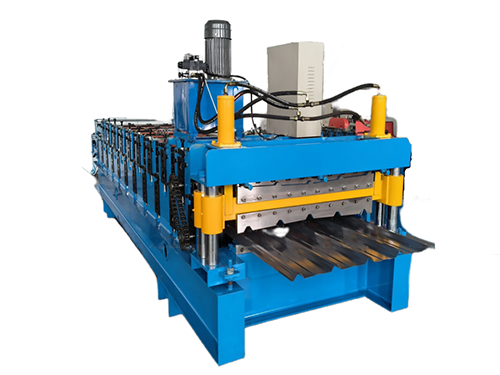
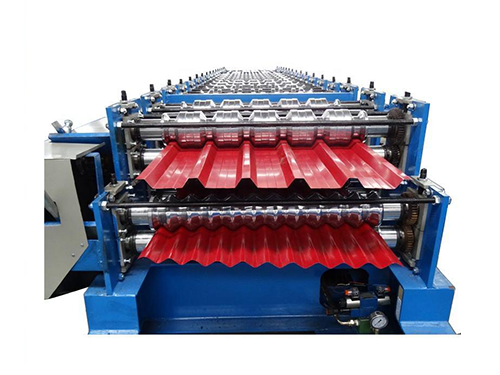
Double-layer roll forming machines combine two profile lines on one frame,saving workshop space and allowing faster switching between two tile profiles.Because the upper and lower layers share the main frame,transmission system,control system,and hydraulic unit,proper installation and precise alignment are especially important.Correct setup helps prevent sheet misalignment,uneven forming,abnormal noise,and unstable cutting.
Installation Precautions
Before installation,confirm that the foundation is flat,stable,and strong enough to support the machine weight.Uneven flooring may cause frame distortion and affect roller alignment.Leveling shims can be used under the machine frame if necessary.
Keep sufficient space around the machine for operation,maintenance,and coil loading.The decoiler,feeding guide,main forming unit,cutting system,and product support table should be arranged in a straight line.If the decoiler is too close to the main unit or not centered,the strip may enter the machine at an angle and cause tracking problems.
Check all electrical connections,PLC signals,encoder wiring,and motor rotation direction before starting.The hydraulic oil level,oil pipe connections,and cutting blade movement should also be inspected.During the first test run,use manual mode to confirm that the forming rollers,cutting unit,and length measuring system work normally.
Key Alignment Steps
The forming rollers must be aligned along the same centerline from the first stand to the last stand.The upper and lower rollers should have uniform gaps on both sides,and the roller shafts should remain parallel.Incorrect roller alignment can cause uneven pressure,edge deformation,or panel twisting.
For double-layer machines,adjust and align the lower layer first.After the lower layer produces stable,straight panels without misalignment,proceed to adjust the upper layer.This step-by-step method prevents interference between the two layers and makes troubleshooting clearer.
The feeding guide and entry rollers should direct the sheet into the first forming stand straight and centered.If the entry guide is misaligned,the strip may drift sideways during production.The cutting unit must also be aligned with the formed profile to ensure clean and accurate cuts.
Common Causes of Sheet Misalignment
Sheet misalignment usually does not mean the machine is defective.It is often caused by uneven feeding,inconsistent roll gaps,misaligned rollers,loose locknuts,unstable tension,or an off-center decoiler.If the left and right roll gaps are not equal,the sheet will be pressed more on one side and gradually move toward the opposite side.
Material quality also affects tracking.Coils with uneven width,poor edge condition,high internal stress,or inconsistent thickness may increase the risk of misalignment.Before adjustment,always confirm that the raw material is suitable for the machine and that the decoiler centerline matches the machine centerline.
Misalignment Adjustment Methods
If the sheet runs to one side,first check the decoiler,feeding guide,and entry roller position.Then check whether the first and last roller stands are aligned.A straight line or laser alignment tool can be used to confirm that the roller centerlines are consistent.
A practical adjustment rule is:if the sheet runs to the right,slightly raise or adjust the left side of the feeding frame or lower the corresponding right-side roller base;if it runs to the left,adjust the opposite side.The upper roller should follow the adjustment of the lower roller,and both sides must remain symmetrical.
If only one stand causes misalignment,adjust that stand carefully.Check the locknuts,bearing seats,and roller gaps.Use a feeler gauge to make sure the gap between the upper and lower rollers is equal on both sides.After adjustment,run a short test and observe the sheet movement through each forming station.
Final Commissioning and Maintenance Tips
After alignment,perform trial production and check the finished panels for straightness,profile accuracy,edge quality,and cutting length.If defects appear,recheck the roller centerline,roll gaps,feeding tension,and cutting alignment.
For long-term stability,keep the rollers clean,lubricate chains and bearings regularly,and check hydraulic oil level and cutting blade condition.Roller adjustment,PLC parameter changes,and hydraulic system maintenance should be performed by trained personnel.With proper installation,careful alignment,and regular maintenance,a double-layer roll forming machine can deliver stable forming quality and reliable performance in overseas production environments.

CONTACTS
Contact:+86 15075795678
URL:www.xiangyirollformingmachine.com
ADD:Jiajializhuang Village, Bo Town, Botou City, Cangzhou City, Hebei Province, China