


- WEBSITE -





Current location: HOME > NEWS > Frequently Asked Questions >
Solutions for Burrs on Double-Layer Roll Forming Machines During Cutting
Time:2026-10-29 04:50:28 Author:xiangyi Click:125
When cutting color steel tiles,if the cut edges exhibit burrs,hanging edges,or incomplete cuts,it not only compromises the appearance of the finished product but also increases subsequent manual trimming costs and reduces production efficiency.The issue of burrs is usually not caused by a single factor;rather,it is the combined result of blade condition,blade clearance,hydraulic pressure,shearing alignment,and material condition.Through standardized troubleshooting and precise adjustments,most burr issues can be resolved on-site.
Main Causes of Burr Formation
The shearing process in a roll forming machine involves the relative cutting action of upper and lower blades.Under ideal conditions,the sheet is cleanly severed at the cutting edges,resulting in a smooth cross-section without obvious burrs.If the clearance between the upper and lower blades is too large,the sheet will be excessively stretched during shearing,forming a tear zone and causing burrs on the cut edge.Conversely,if the clearance is too small,the cutting edges will excessively squeeze the sheet,increasing shearing resistance and potentially accelerating blade wear or causing localized chipping.
When the blade edges become dull,chipped,or have adhered iron filings,the shearing performance significantly degrades.After prolonged use,the edges lose their sharpness;instead of being"cut,"the sheet is"squeared"or"torn,"leading to burr formation on the cut edges.
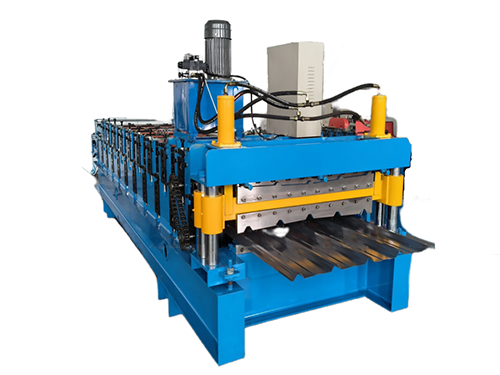
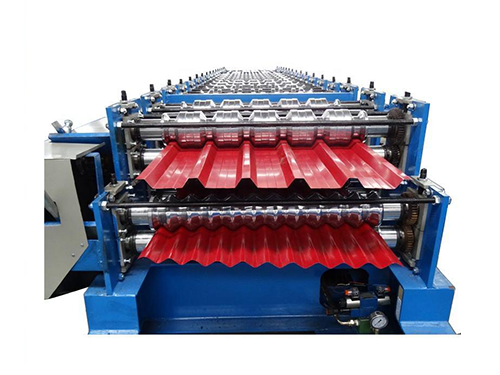
Additionally,non-parallel upper and lower blades,loose cutter seat guides,insufficient hydraulic pressure,sheet misalignment,and significant thickness fluctuations can cause uneven shearing forces.This is especially common in double-layer roll forming machines where both layers share the same shearing system.If the shearing device is not aligned with the forming channel,or if the blade installation position is offset,it is more likely to result in prominent burrs on one side while the other side remains relatively smooth.
Inspecting Blade Condition
When burrs are detected on the cut edge,the machine should be stopped immediately to inspect the blade edges.Check for obvious wear,chips,curled edges,or adhered metal debris.If the edge surface is rough,shiny,or shows clear signs of dullness,the blades need to be ground or replaced.
For alloy blades such as Cr12MoV,worn edges can be reground on a grinding machine to restore sharpness before reinstalling.During grinding,it is crucial to maintain the straightness and parallelism of the cutting edge,avoiding grinding only one side,which can lead to uneven shearing clearance.Before installation,clean any iron filings and oil from the blade surface.Demagnetization treatment may also be necessary to prevent fine iron filings from re-adhering to the cutting edge.
Adjusting Upper and Lower Blade Clearance
The clearance between the upper and lower blades is a critical parameter affecting shearing quality.Excessive clearance results in prominent burrs,while insufficient clearance increases shearing resistance,accelerates blade wear,and may even cause edge chipping.
To adjust,lower the cutter to bring the upper and lower blades close to the shearing position,then use a feeler gauge to check the blade clearance.The clearance should be fine-tuned based on the sheet thickness and material,typically using a certain percentage of the sheet thickness as a reference,combined with test cut results to determine the optimal value.After adjustment,check multiple points along the entire length of the blade to ensure the left and right clearances are uniform,avoiding a situation where one side is tight and the other is loose.
If the equipment uses set screws or adjustment bolts,the position of the bottom blade can be fine-tuned via the front and rear set screws.Adjustments should be made in small increments;after each adjustment,jog the machine for a test cut to observe changes in the cut edge.If abnormal impact noises are heard,it indicates excessive adjustment or uneven clearance,and the adjustment should be rechecked and rolled back.
Checking Blade Parallelism and Overlap
The upper and lower blades must not only have the appropriate clearance but also remain parallel.If the blade mounting surface is uneven,the cutter seat guide is worn,or the fixing bolts are loose,the cutting edges will make uneven contact during shearing,causing localized burrs or incomplete cuts.
During adjustment,use thin paper or a feeler gauge to check the contact condition along the length of the cutting edge.For roll forming machine shearing systems,the upper and lower blades should typically maintain an appropriate overlap to ensure a clean shearing action.If the overlap is too small,the sheet may not be completely cut;if it is too large,it will increase blade wear and hydraulic load.Generally,start with a smaller overlap and gradually optimize it through test cuts.
Checking the Hydraulic System and Shearing Action
Insufficient hydraulic pressure leads to inadequate shearing force,causing the sheet to deform under compression during cutting and making burrs more likely.Check whether the hydraulic station oil level is normal,the pressure gauge readings are stable,the solenoid valves operate responsively,and the cylinders have internal leakage or sticking.
If the shearing action is slow or weak,check the hydraulic system pressure setting and adjust it appropriately to the manufacturer's recommended range.However,the pressure should not be too high,as this will increase the load on the blades,cylinders,and frame,shortening the service life of the components.Before continuous production,perform a test cut with a short piece of material to confirm that the cut edge is smooth and the cut is clean.
Correcting Shearing Alignment
When switching tile profiles on a double-layer roll forming machine,ensure that the shearing device is aligned with the currently active forming channel.If the sheet is misaligned when entering the shearing station,the blades will experience uneven forces,making burrs more likely to form on one side of the cut.
To address this,check whether the formed panel is centered as it enters the shearing station and whether the cutter seat is perpendicular to the width direction of the sheet.If the left and right guides,slide clamping strips,or cutter seat fixing bolts are loose,tighten them promptly.Excessive clearance in the shearing system guides can also cause the cutter frame to wobble during its downward stroke,affecting shearing precision.
Optimizing Material and Production Parameters
The material itself also affects shearing quality.If the incoming material has significant thickness deviations,damaged edges,uneven internal stress,or hard impurities on the surface,localized burrs are likely to occur during shearing.Before production,confirm that the material specifications fall within the equipment's applicable range to avoid long-term shearing of excessively thick or hard materials,which causes rapid blade wear.
If the forming speed is too fast,the sheet still has significant inertia at the moment of shearing,which can also affect cut quality.For thinner color-coated sheets or those with softer coatings,appropriately reducing the running speed before shearing can help keep the sheet stable during the cutting process.Additionally,maintain stable uncoiling tension to prevent the sheet from shaking or misaligning before and after the shearing station.
Daily Maintenance Recommendations
To reduce burr issues,it is recommended to establish a regular maintenance schedule.Before each shift,check the blade edge condition,blade clearance,hydraulic pressure,and guide fixation.After stopping the machine,clean iron filings and dust around the blades to prevent debris from getting trapped in the cutting edge and causing chipping.Transmission chains,guides,bearings,and other components should be lubricated periodically to ensure smooth and reliable shearing action.
Blade adjustments,hydraulic system maintenance,and shearing parameter modifications should only be performed by trained personnel.For overseas customers,the equipment manual should clearly outline the burr troubleshooting steps,including blade inspection,clearance adjustment,pressure verification,alignment correction,and test cut validation.Through a stable shearing system design,reliable blade materials,clear maintenance guidelines,and convenient adjustment structures,double-layer roll forming machines can maintain smooth cut edges and stable production efficiency in various market environments over the long term.

CONTACTS
Contact:+86 15075795678
URL:www.xiangyirollformingmachine.com
ADD:Jiajializhuang Village, Bo Town, Botou City, Cangzhou City, Hebei Province, China